Sunday Night Dispatch from a Cabin in Alaska
A late-night dispatch from an Alaska cabin covering AI-powered productivity, marketing lessons learned the hard way, and building in the quiet.
I'm sitting in my cabin in Caswell Lakes, Alaska right now. It's about 11 o'clock on a Sunday night, my dog Aspen is curled up next to me, and it's so quiet outside that you could hear a snowflake hit the ground. Tomorrow's Presidents' Day, which means I don't have to be anywhere, and I've been telling myself I need to write more. Real content. Stuff that comes from my own brain and not from an LLM.
That's kind of ironic considering how much I've been working with AI lately. But I think that's exactly why it matters. So here I am, writing.
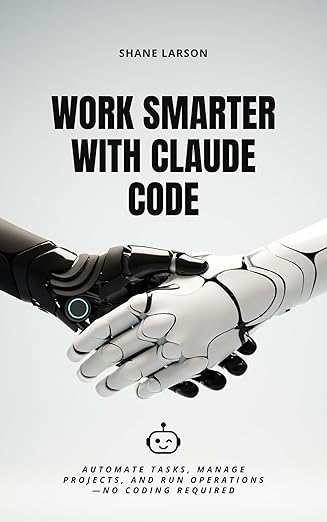
Work Smarter with Claude Code: Automate Tasks, Manage Projects, and Run Operations—No Coding Required
AI that sees your files and does the work. Organize chaos, automate tasks, escape spreadsheet hell. No coding required. Practical guide for knowledge workers.
Learn MoreWorking Harder Than Ever
Since I started using agentic software development tools, I feel like I work harder than I ever have in my career. That might sound counterintuitive. Isn't AI supposed to make things easier? Well, sort of. What it actually does is remove the bottlenecks that used to slow you down, which means you can get way more done than you could ever get done before. The ceiling on your productivity just disappears.
I recently solved an incredibly difficult problem at work using Claude Code in about 30 minutes. Something that my lead engineer was completely stuck on. Something that was creating a major problem for the team. I don't want to share the specifics, but it was one of those mind-blowing moments where you sit back in your chair and think, "Did that really just happen?"
And when it was done, I didn't just walk away from it. I had Claude Code self-document what it did, write up a Word doc with diagrams explaining the solution, and produce instructions for how to handle it if the issue ever comes up again. So now it lives in our team documentation. That's the part people don't always think about with these tools. It's not just about solving the problem. It's about solving it and leaving behind something useful for the next person.
What's New at Grizzly Peak Software
I've been pouring a lot of energy into Grizzly Peak Software these last few weeks. Two big additions.
First, I added a technical library with over 500 articles. We're talking deep dives into Azure DevOps, cloud compute, AI integration, Node.js, and a bunch of other topics that I've accumulated real-world experience with over more than a decade. The site now has well over 500 articles, and I'm planning to keep expanding it. These aren't fluff pieces. They're the kind of practical, working-code-included reference material that I wished existed when I was grinding through production issues at 2 AM.
Second, I launched a job board specifically for burned-out software engineers. This one came from the data. I noticed in my analytics that certain articles on my site consistently resonate more than others, and they're almost always the ones about engineers who are burned out and looking for something different. There's a real hunger out there for alternative career paths.
So I built Alternative Careers for Software Engineers, which is a curated job board powered by AI. Every day it goes out to various job feeds, grabs relevant listings based on my queries, scores them for things like remote work options and burnout-friendly signals, and loads them into the database. It's a programmatic SEO play, sure, but the core motivation is that I genuinely want to help people. I've been the burned-out engineer. I know what it feels like to open LinkedIn and see nothing but the same kind of roles that are making you miserable.
Auto Detective: A Programmatic SEO Experiment
My automotive AI site, autodetective.ai, has been an interesting experiment. I ran some Facebook ads for it. Made a cute video of my dog talking, saying "I'm gonna fix your car, just come to Auto Detective AI." People loved it. Lots of clicks, lots of shares. But no real leads.
Here's the thing though. When you look at Google Search Console, this application is less than one month old, and it already has thousands of pages indexed in Google. That's the power of programmatic SEO. Every time someone asks the AI a question, it generates a detailed article about that scenario. Each page is written by Claude Opus 4.6, so these aren't crappy template pages. We're talking 4,000 to 6,000 words with actual helpful DIY content.
The play is simple: over time, as the article count grows into the tens of thousands, someone is going to Google a very specific car problem, land on my page, and hopefully click an affiliate link for an OBD2 scanner or something similar.
Now, here's where it gets real. Google AdSense rejected me. They could tell the content was AI-generated. That's frustrating but also instructive. It means I need to figure out how to enrich the content further. Maybe add a DIY mechanic encyclopedia, more helper content, things that feel more handcrafted. That's on the roadmap.
As for the leads side of the business, I got exactly one lead, and it was a scammer filling out my form. Claude actually told me months ago not to worry about building out automated lead-chasing infrastructure until I actually had leads to chase. That was good advice. I should have listened sooner instead of worrying about a problem that doesn't exist yet.
What I've Learned About Marketing (The Hard Way)
I've been learning a lot about marketing lately, and most of what I've learned has cost me money.
Here's the fundamental structure: you create a landing page, you advertise to drive traffic to it, there's a call to action, and you try to funnel people into some kind of sales pipeline. Maybe it's just capturing an email. Maybe it's an impulse buy. Maybe it's a long sales cycle for enterprise software. The mechanics are always the same.
With voding.ai, my AI tools application, I spent about $100 on ads. I got around 100 signups, about 250 free demo trials, and exactly one paying customer. That's $100 invested to get $10 in revenue.
But here's what was interesting: Google Analytics showed that organic and social traffic was surprisingly high. People saw my ads and shared them. So advertising had a secondary effect I didn't expect. It seeded organic discovery.
The problem is the economics. When your product only generates $10 per transaction, there's basically no margin. People can go to ChatGPT, probably the free version, and do roughly the same thing. They know that. So they're clicking your ad on impulse, they land on your page, they think "Oh, cool… but not that cool," and they bail. That's what happens.
This experience taught me something important about the difference between building things and building businesses:
If you're selling a low-ticket novelty like a caricature generator or pet portrait tool, you're fighting an uphill battle on margins. You need either massive volume or you need to rethink what you're offering entirely.
If you want real margin, you need a SaaS application that solves a more complex problem with higher value to the customer. Something you can charge $20,000 to $100,000 or more per year for. Think Salesforce. Think about how when a company buys their MuleSoft API platform, some of those contracts are millions of dollars a year just to host APIs. Those are high-value sales situations with real pipelines. They take six months to close. But they're worth it.
The same lesson applies to Amazon Kindle ads, Facebook ads, all of it. I've run ads across multiple platforms at this point, and the pattern is always the same: you spend hundreds of dollars, people click but don't convert, and you end up with no profit. I don't understand how some companies stay alive doing this. They must just dump money into marketing and hope for the best.
Building an Agentic Loop (and Understanding Claude Code)
On the technical side, I wrote a book called How to Train Your Own LLM: A Python and PyTorch Guide. It comes with a companion GitHub repository that walks you through building a small language model from scratch. The model it produces is tiny, trained on maybe 10,000 characters. Obviously, if you want to build something like GPT-3.5, which is considered small by today's standards, you'd still need hundreds of thousands or millions of dollars in compute. But the book teaches the fundamental concepts, and from there, people can apply that learning wherever they want.
I also built a basic agentic loop in JavaScript. An agentic loop, for those unfamiliar, uses tools in a loop until it solves an objective. There's a feedback mechanism where the human stays in the loop, iteration limits, and some other guardrails. It's bare bones, but it works.
Building that got me thinking about how Claude Code actually works under the hood. And it turns out it's basically the same concept, except instead of custom tools, it uses MCP (Model Context Protocol) for everything. It's very Claude-centric and MCP-only.
That realization connected a lot of dots for me. I've been building MCP servers, like my Azure DevOps MCP server, and using them with Claude Code to do things that would blow most people's minds. I ran an experiment where Claude Code autonomously project-managed and developed a feature, using an agile kanban-style system on Azure DevOps. It completed work that would have taken a team two to three weeks. It did it in about 20 minutes.
The Cabin
I should probably tell you about where I'm writing this from.
I bought this land in Caswell Lakes, Alaska in 2014. I moved here with this dream of building a cabin, and back then I was maybe more idealistic than I am today. I didn't want to leave a big impact on the land. So for the first two years, I didn't even build a driveway. I wanted to keep it pristine.
I started with what I call my tiny cabin, an 8-by-12 foot structure that's basically a shed with a small sleeping loft. I used to stay in that while I was building the main cabin, which is 16 by 20 feet. It's got a small kitchen, a wood stove, a futon in the living room, a table, a sleeping loft with a queen bed, and a bedroom with another queen bed. Six people could technically sleep here, though it'd be tight. But it's cozy.
I own three lots side by side, about an acre and a half. No one can disturb me here. It's the middle of winter in Alaska right now, and it's just so, so quiet. My dog and I are just chilling.
This is the kind of place where you can think clearly. Where you can write something that actually comes from your own head, and not from an LLM.
So that's what I'm doing tonight.
Shane is a software engineer, writer, and the founder of Grizzly Peak Software. He builds things from his cabin in Alaska and writes about AI, software engineering, and what comes next. You can find him at grizzlypeaksoftware.com.