Mentorship Reverse: What Younger Devs Taught Me About AI
I spent most of my career being the guy who knew things.
I spent most of my career being the guy who knew things.
Thirty years in software will do that. You accumulate knowledge like sediment — layers of hard-won lessons about database indexing, distributed systems, the seventeen ways a production deployment can go sideways at 2 AM. When a junior developer had a question, I had an answer. That was the deal. That was the implicit hierarchy.
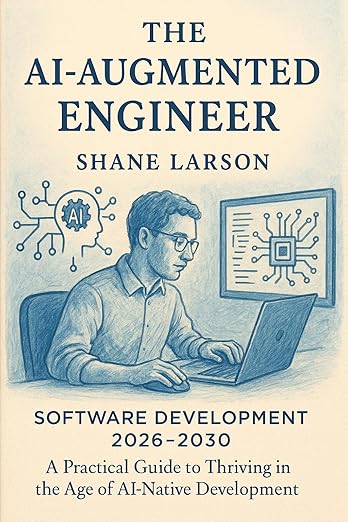
The AI Augmented Engineer: Software Development 2026-2030: A Practical Guide to Thriving in the Age of AI-Native Development
By 2030, 0% of IT work will be done without AI. Data-backed career roadmap for software engineers. No hype, no doom. Practical strategies that work.
Learn MoreThen AI happened. And the hierarchy flipped.
I'm not being dramatic. Over the past two years, I've learned more from developers half my age than I learned from senior engineers during my first decade in the industry. Not about fundamentals — I still know more about system architecture and failure modes than most of them will know for years. But about the tools, the workflows, the mental models for working with AI rather than around it. The younger devs weren't just faster at adopting AI. They were thinking about it differently than I was.
Here's what they taught me, and why I think reverse mentorship might be the most underrated practice in our industry right now.
The First Lesson: Stop Treating AI Like a Junior Developer
I was pairing with a 26-year-old developer named Marcus on a project last year. We were building an API integration layer, and I was using Claude the way I'd use a junior teammate — giving it extremely specific instructions, reviewing every line with suspicion, essentially dictating the code I wanted and using the AI as a fancy autocomplete.
Marcus watched me do this for about twenty minutes and then said something that genuinely changed how I work: "You're bottlenecking yourself. You're still the one doing all the thinking."
He showed me his approach. Instead of dictating implementation details, he described the problem at a higher level. Instead of reviewing AI output line-by-line for correctness, he wrote tests first and let the output prove itself. Instead of one careful prompt, he'd iterate rapidly — generate, test, refine, regenerate.
The difference in throughput was staggering. Not because his code was better than mine — it often wasn't, at first — but because his feedback loop was ten times faster.
I realized I'd been treating the AI the same way bad managers treat junior developers: micromanaging every detail instead of setting clear expectations and evaluating outcomes. The irony was not lost on me. I'd spent years telling junior devs to stop waiting for permission and start solving problems. Then I refused to let the AI do the same thing.
// How I was prompting (the micromanager approach):
// "Write a function that takes a user object with fields name, email,
// and role. Validate that name is a non-empty string, email matches
// a regex pattern, and role is one of 'admin', 'editor', or 'viewer'.
// Return an object with isValid boolean and an errors array..."

// How Marcus prompted (the outcome-focused approach):
// "I need input validation for user registration. Here's my User schema
// and my test file with edge cases. Make all tests pass."

var validateUser = function(user) {
  var errors = [];

  if (!user || typeof user !== 'object') {
    return { isValid: false, errors: ['Invalid user object'] };
  }

  if (!user.name || typeof user.name !== 'string' || user.name.trim().length === 0) {
    errors.push('Name is required and must be a non-empty string');
  }

  var emailPattern = /^[^\s@]+@[^\s@]+\.[^\s@]+$/;
  if (!user.email || !emailPattern.test(user.email)) {
    errors.push('Valid email address is required');
  }

  var validRoles = ['admin', 'editor', 'viewer'];
  if (!user.role || validRoles.indexOf(user.role) === -1) {
    errors.push('Role must be one of: ' + validRoles.join(', '));
  }

  return {
    isValid: errors.length === 0,
    errors: errors
  };
};
The code looks the same either way. But Marcus got there in one iteration because he let the tests drive the conversation. I got there in four because I was trying to control every variable upfront.
The Second Lesson: Your Experience Is a Filter, Not a Foundation
A developer named Priya — she was maybe 24 at the time — told me something during a code review that I've thought about almost every day since.
I'd rejected an AI-generated architecture suggestion because it used an event-driven pattern where I would have used request-response. My reasoning was experience-based: I'd seen event-driven systems become unmaintainable nightmares, so I defaulted to what I knew worked.
Priya pushed back. "Your experience is telling you what went wrong before," she said. "But the tools are different now. The failure modes you're avoiding might not apply anymore."
She was right. The event-driven architecture the AI suggested included built-in observability patterns and dead letter queues that addressed most of the maintainability issues I'd experienced in the past. The AI wasn't ignoring my hard-won lessons — it was incorporating solutions to problems I'd encountered but hadn't realized had been solved.
This was humbling. My thirty years of experience had become a filter that was protecting me from past mistakes but also blocking me from better solutions. I wasn't evaluating the AI's suggestion on its merits. I was rejecting it because it pattern-matched to something that hurt me in 2014.
The younger devs didn't have that baggage. They evaluated each suggestion fresh, which meant they were more open to approaches that experienced engineers had written off years ago.
I'm not saying experience doesn't matter — it absolutely does, and I've watched junior devs accept AI suggestions that had obvious security holes or scalability problems that only experience would catch. But experience needs to be a checkpoint, not a roadblock. You evaluate the suggestion against what you know, but you don't reject it just because it reminds you of something that went wrong a decade ago.
The Third Lesson: Prototype Speed Matters More Than Prototype Quality
I come from an era where you designed before you built. You drew architecture diagrams. You wrote specs. You thought carefully about interfaces and data models before writing a single line of code.
A 28-year-old developer named Jake showed me a different approach during a hackathon we did together. He built three complete prototypes in the time it took me to finish designing one.
His prototypes were rough. Some of them were genuinely bad. But by the time I had my one careful design ready to implement, Jake had already learned which approach worked best through actual experimentation. He'd tried event sourcing, found it was overkill for our use case, pivoted to a simpler CRUD approach, discovered a caching issue, and solved it — all while I was still deciding between PostgreSQL and MongoDB.
// Jake's rapid prototyping workflow
var express = require('express');
var app = express();

// Prototype 1: Direct database approach
// Time to build: 20 minutes
// Result: Works but slow for read-heavy loads

// Prototype 2: With Redis caching layer
// Time to build: 25 minutes
// Result: Fast reads but cache invalidation is messy

// Prototype 3: Materialized view pattern
// Time to build: 30 minutes
// Result: Best balance of speed and simplicity

// Total time: 75 minutes, with real data about what works
// vs. my approach: 90 minutes of design, still no data

var buildPrototype = function(approach, config) {
  var startTime = Date.now();

  // Let AI generate the boilerplate for each approach
  // Focus human attention on evaluating results, not writing code

  return {
    approach: approach,
    buildTime: Date.now() - startTime,
    testResults: null,  // filled in after running actual load tests
    keepExploring: true
  };
};
The lesson wasn't that design doesn't matter. It's that AI has changed the cost of prototyping so dramatically that building and testing is now often faster than designing and predicting. When the cost of building drops to near zero, the calculus shifts. You can afford to be wrong three times if being wrong takes twenty minutes each time.
I still design systems for production. But for the exploration phase? I prototype now. Jake taught me that.
The Fourth Lesson: Read the AI's Reasoning, Not Just Its Output
This one came from a developer named Sofia, who was 25 and had been using AI tools since college — meaning she had more years of AI-assisted development than most senior engineers, despite having far less total experience.
I was copying code from AI outputs and pasting it into my projects. Sofia was reading the explanations, the reasoning, the "here's why I chose this approach" sections that I was skipping.
"You're treating it like Stack Overflow," she told me. "You're grabbing the answer and ignoring the explanation. But the explanation is where you learn things."
She showed me her workflow. When the AI generated code, she'd read through the reasoning first. Not to verify correctness — to learn patterns. She'd absorbed design patterns, performance optimization techniques, and architectural approaches by actually reading what the AI was explaining about its own suggestions.
This is the part that bruised my ego the most. I'd been a senior engineer for fifteen years. I didn't think I needed to learn patterns from an AI. But Sofia was right — the AI was synthesizing knowledge from millions of codebases, and its reasoning often surfaced approaches I'd never encountered. Not because they were new, but because my experience was necessarily limited to the systems I'd personally worked on.
I started reading the reasoning. My code got better. Not because the AI was smarter than me, but because it had breadth where I had depth.
The Fifth Lesson: Pair with AI Like You'd Pair with a Human
The youngest developer who taught me something important was Chris, who was 23 and had never professionally coded without AI assistance. To him, AI wasn't a tool — it was a collaborator. The distinction matters.
Chris talked to the AI. Not literally (well, sometimes literally), but conversationally. He'd share context about the project, explain constraints the AI couldn't see, push back when suggestions didn't fit, and build on ideas the AI proposed. It was pair programming in a real sense, not just autocomplete with extra steps.
I'd been using AI transactionally. Here's a task, give me the code, I'll evaluate it. Chris used it relationally. Here's what we're building, here's what I'm thinking, what am I missing?
The relational approach surfaced better results because the AI had more context to work with. Chris's conversations with AI read like actual pair programming sessions:
"I'm thinking about using a queue here but I'm worried about message ordering. The upstream system sends events that sometimes arrive out of order, and we need to process them sequentially per user but can parallelize across users. What patterns would you suggest?"
Compare that to my typical prompt: "Write a message queue consumer that processes events in order per user."
Same problem. But Chris's approach gave the AI room to suggest things he hadn't considered, while mine constrained the AI to exactly what I already knew I wanted.
What I Still Bring to the Table
I want to be honest here: reverse mentorship doesn't mean the younger devs have nothing to learn from experienced engineers. They absolutely do. I've watched junior developers accept AI-generated code with SQL injection vulnerabilities, deploy architectures with single points of failure that would collapse under real load, and trust AI reasoning that was confident but completely wrong.
Experience gives you a calibrated sense of risk. It gives you the ability to look at a system and know — from having been burned — where the failure points are. It gives you judgment about what matters and what doesn't when deadlines are real and users are waiting.
The younger devs taught me how to use AI tools better. I taught them how to evaluate what those tools produce. Both skills are essential.
The best teams I've worked on recently are the ones where this exchange happens naturally. Where the 23-year-old shows the 52-year-old a new prompting technique, and the 52-year-old explains why the AI's suggested database schema will fall apart at scale. Where nobody's ego is more important than the outcome.
How to Set Up Reverse Mentorship (Practically)
If you're a senior engineer and you're not actively learning from younger developers, here's how to start:
Schedule it intentionally. Don't wait for it to happen organically. Ask a junior developer to show you their AI workflow. Be specific: "Can you walk me through how you'd approach this feature using AI tools?" Most junior devs will be flattered that you asked.
Pair on real work. Don't do abstract exercises. Work on an actual ticket together, with the junior developer driving. Watch their process without interrupting. Take notes on what surprises you.
Ask "why" without judgment. When they do something you wouldn't do, ask why. Not "why would you do that?" (which sounds like criticism) but "what's your reasoning here?" (which sounds like genuine curiosity). You might learn something. You might also identify a gap in their knowledge. Both are valuable.
Be willing to change. This is the hardest part. If a younger developer shows you a better workflow, adopt it. Don't nod politely and go back to your old habits. Actually change. Your thirty years of experience are valuable, but they're not a reason to resist better approaches.
// A simple reverse mentorship tracking approach I use
var mentorshipLog = function(session) {
  return {
    date: new Date().toISOString(),
    mentorName: session.juniorDev,
    topicLearned: session.topic,
    actionItem: session.whatIllChangeTomorrow,
    applied: false  // update this when you actually apply the lesson
  };
};

// The 'applied' field is the accountability mechanism
// If most of your entries stay false, you're not actually learning
// You're just being polite
The Uncomfortable Truth
Here's what nobody over 40 wants to hear: the younger developers are better at AI than we are. Not because they're smarter — they're not. Not because they understand the underlying technology better — most of them don't. They're better because they don't have thirty years of habits to unlearn.
They grew up in a world where talking to a computer and getting intelligent responses was normal. They don't have the instinctive distrust that comes from decades of tools that promised intelligence and delivered keyword matching. They approach AI with curiosity instead of skepticism, which means they explore the edges of what's possible while we're still arguing about whether it's reliable enough to use.
The skepticism has value — I catch problems they miss, regularly. But the curiosity has value too, and I was missing it until younger developers showed me what I was leaving on the table.
I'm 52 years old, sitting in a cabin in Alaska, and some of the most important things I've learned recently came from people who weren't alive when I wrote my first line of production code. That's not a failure of experience. That's mentorship working the way it's supposed to — in both directions.
The best engineers I know have always been learners first and experts second. The technology changed. The principle didn't.
Shane Larson is a software engineer and the founder of Grizzly Peak Software. He writes about software development, AI, and building real things from a cabin in Caswell Lakes, Alaska. You can find more of his work at grizzlypeaksoftware.com.