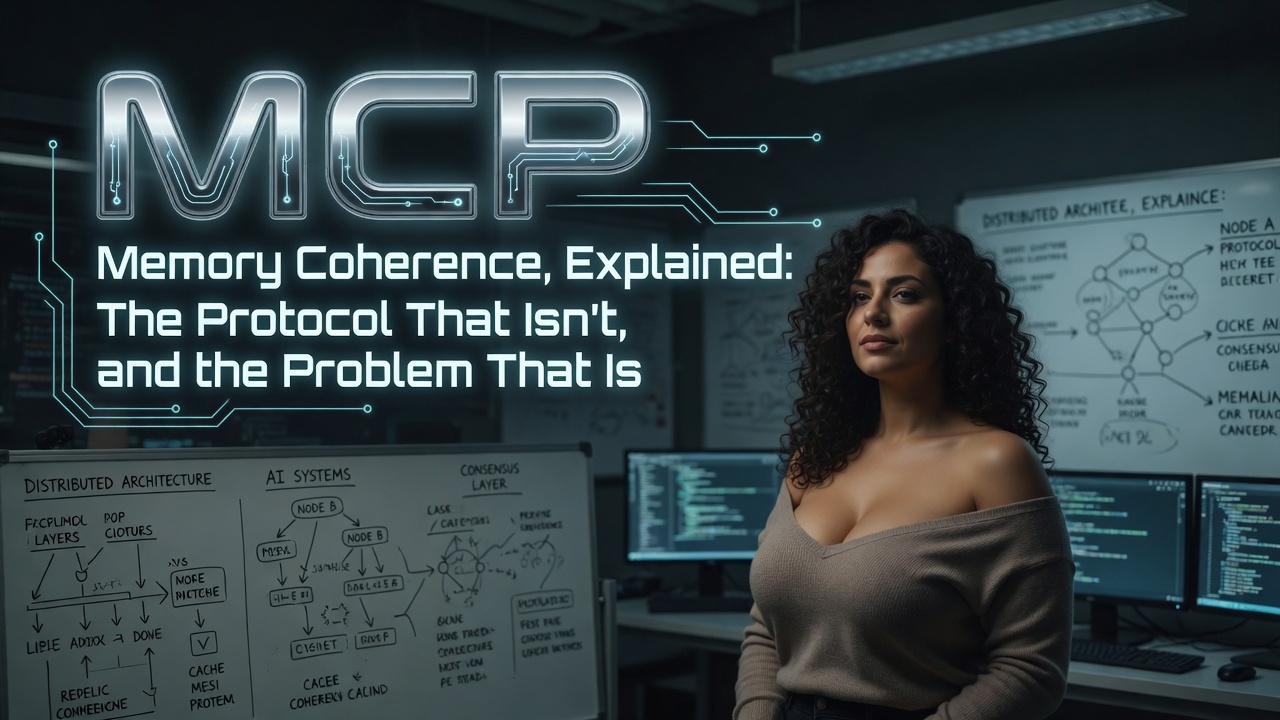
MCP Memory Coherence, Explained: The Protocol That Isn't, and the Problem That Is
There is no MCP memory coherence protocol. There is a 50-year-old distributed systems problem, and four patterns that actually fix it.
People keep searching for the "MCP memory coherence protocol" as if it were a spec they can go read. It is not. There is no blessed standard by that name, no RFC, no section of the Model Context Protocol docs that defines it. What there is, and what everyone is actually bumping into, is one of the oldest problems in computing wearing a new coat.

The 90-Day AI Transformation: A Week-by-Week Playbook for CIOs Who Need Results Now
Stop planning your 18-month AI roadmap. This week-by-week playbook takes tech leaders from zero AI deployments to measurable production results in 90 days.
Learn MoreMemory coherence is the question of what happens when more than one thing holds a copy of the same state and one of them changes it. CPU designers have fought this for decades. Now that we are wiring up fleets of agents that each carry their own working memory and talk to shared MCP servers, we have imported the exact same problem into the AI stack, and most teams are discovering it the hard way, in production, when two agents confidently disagree about a fact they were both supposed to know.
Let me explain what is really going on, because the name is misleading and the misunderstanding is expensive.
Borrow the analogy that already exists
A multi-core CPU gives each core its own cache. When core A writes a value and core B still holds the old copy, you have an incoherent view of memory. Decades of hardware engineering went into coherence protocols, MESI and its cousins, to guarantee that a read always returns the most recent write no matter which core did the writing.
Swap "core" for "agent" and "cache" for "context window or memory store" and you have described the entire problem space that the phrase "memory coherence" points at in an agent system. Agent A learns a fact and writes it to memory. Agent B, running in parallel, is still operating on what it loaded a minute ago. B acts on a stale truth. Nobody threw an error. The system just quietly did the wrong thing.
That is the problem. It is a distributed systems problem, not a prompt problem, and it does not have a turnkey protocol you can install.
Why MCP makes this sharp
MCP is, by design, a stateless client-server interface. It standardizes how a model asks a server for tools, resources, and context over JSON-RPC. What it deliberately does not do is give every agent and server a shared global brain. Each server answers each request on its own. The protocol moves context around, it does not keep everyone's memory consistent.
Researchers have a name for the failure that falls out of this: the disconnected models problem, the difficulty of holding coherent context across many agent interactions when no participant owns the whole picture. In a single-agent, single-session tool call, you never notice. The moment you fan work out across parallel agents that read and write shared memory, coherence stops being automatic and becomes something you have to engineer.
Here are the concrete ways it breaks, in the language of an engineer rather than a paper:
- Stale reads. An agent loads memory, does slow work, and acts on a value another agent already changed. It was right when it looked. It is wrong when it acts.
- Lost writes. Two agents read the same record, both modify it, both write back. The second one silently erases the first. No conflict, no warning.
- Split brain. Two agents diverge on the same fact and both keep going, and now your system holds two contradictory truths and no tiebreaker.
- Read-your-own-writes violations. An agent writes something, immediately reads it back through a different server, and does not see its own change because the write has not propagated. This one destroys trust in the system faster than any other.
If you have watched an agent swarm produce confidently inconsistent output, you were watching a coherence failure. It was not the model hallucinating. It was your architecture failing to guarantee a consistent view of shared state.
What actually solves it
There is no protocol to adopt, but there is a set of patterns that work, and they are the same ones distributed systems have used for years. The emerging MCP research, shared context stores and context-aware server collaboration, is essentially these patterns given MCP-shaped names.
Make one place the source of truth. The single most effective move is to stop letting each agent keep private, authoritative memory. Put shared state in one store that every agent and server reads from and writes to. A shared context store is not exotic. It is a database with a consistency guarantee, and it is the foundation everything else sits on. Per-agent scratch memory is fine, as long as it is never the truth other agents depend on.
Decide your consistency model on purpose. Strong consistency means every read reflects the latest write, at the cost of coordination and latency. Eventual consistency is cheaper and faster and means agents can briefly see stale data. Both are legitimate. Choosing by accident is not. For anything where two agents acting on different truths causes real damage, pay for strong consistency and move on.
Version your writes and reject blind overwrites. This kills lost writes. Attach a version to every record. An agent that read version 7 may only write if the store is still at version 7. If someone else got there first, the write is rejected and the agent re-reads and retries. This is optimistic concurrency, and it is a handful of lines:
# optimistic write against a shared context store
record = store.get("customer:1042")          # returns value + version, say v7
new_value = agent.revise(record.value)

try:
    store.put("customer:1042", new_value, expected_version=record.version)
except VersionConflict:
    # someone wrote between our read and our write.
    # re-read the current truth and reconcile, do not clobber.
    fresh = store.get("customer:1042")
    store.put("customer:1042", agent.reconcile(fresh.value, new_value),
              expected_version=fresh.version)
Separate kinds of memory. Episodic memory, the log of what happened, is append-only and rarely conflicts, so it is cheap to keep coherent. Semantic memory, the current agreed-upon facts, is where conflicts live and where your consistency guarantees need to be strict. Treating them as one undifferentiated "memory" blob is how teams end up applying heavy coordination to a log that never needed it and none to the facts that did.
Centralize the decision, distribute the work. The pattern the research calls context-aware MCP is worth stealing: one coordinator establishes the shared starting context, then specialized servers execute against the shared store in parallel. Coherence comes from the single well-defined write path into shared state, not from hoping independent agents happen to agree. This ties directly into how you handle fallbacks and orchestration across models, because a clean shared-state layer is also what lets a retry or a failover pick up exactly where the failed attempt left off.
The takeaway
Stop looking for the MCP memory coherence protocol. It does not exist and you do not need it. What you need is to recognize that the second you run more than one agent against shared memory, you are running a distributed system, and distributed systems have a fifty-year-old playbook for exactly this.
Pick one source of truth. Choose your consistency model deliberately. Version your writes. Separate the log from the facts. Do that, and the confidently-inconsistent-agents problem that sent you searching for a protocol just goes away, because you built the coherence in instead of waiting for a spec to hand it to you.