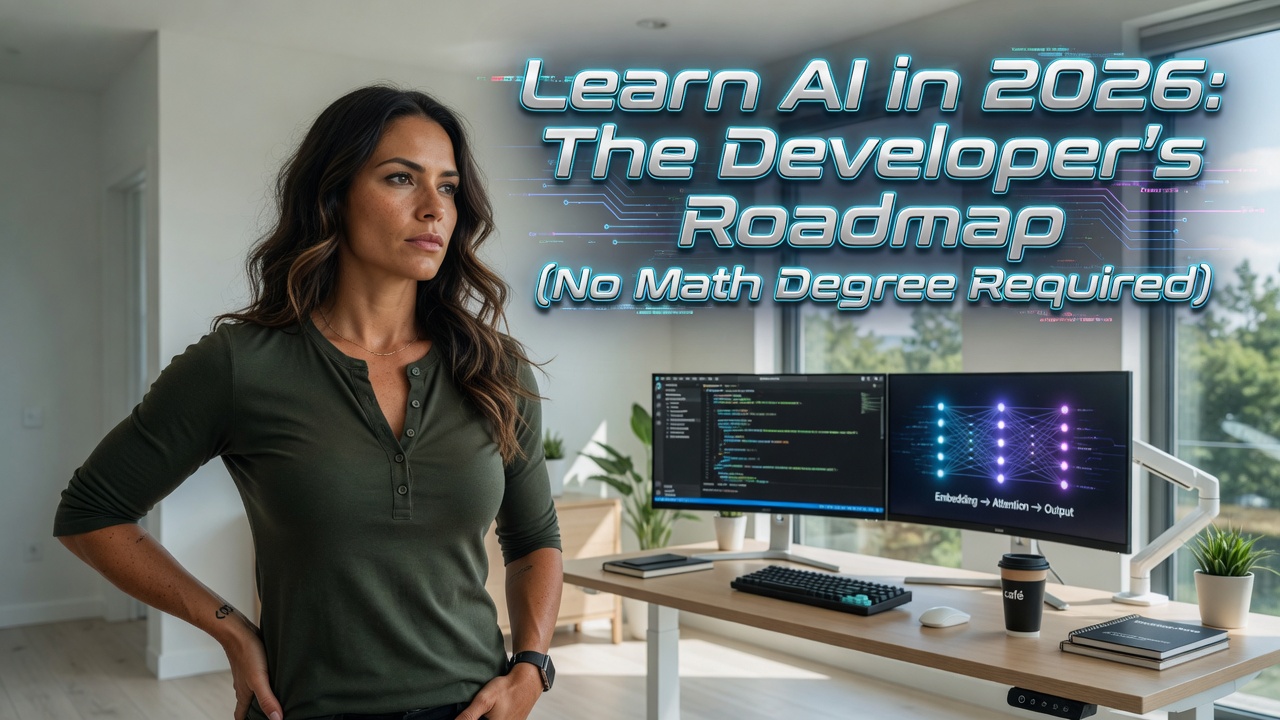
Learn AI in 2026: The Developer's Roadmap (No Math Degree Required)
Most "learn AI" advice targets ML researchers, not engineers who ship. Here's the actual roadmap for developers building with AI in 2026.
That advice is going to cost you months. Here's the roadmap I'd actually follow.
The CIOs Guide to MCP: How Model Context Protocol Connects AI to Your Enterprise and Why It Matters
Stop building custom AI integrations. MCP is the universal standard adopted by Anthropic, OpenAI, Google, Microsoft. CIO guide to enterprise adoption.
Learn MoreThe Trap Every Developer Falls Into
Someone tells you to learn AI. You search around. The top results tell you to start with math: linear algebra, calculus, backpropagation. You buy a textbook. You start a course. Three months later, you haven't shipped a single thing and you've memorized matrix multiplication operations you will never use in a production codebase.
This is the PhD trap. The math matters if you're training foundation models. You're not. You're a software engineer. Your job is to build applications that use these models, not to understand the research paper that produced them.
The landscape flipped somewhere around 2023. The valuable skill is no longer knowing how transformers work. It's knowing how to use them effectively, reliably, and cheaply at scale.
Start With LLM Behavior, Not LLM Math
Before writing a line of code, build a mental model of what LLMs actually do and where they fail. Not the math: the behavior.
Here's what matters for application development:
Context windows: Every model has a limit on how much text it can process in a single request. Your application design lives and dies by this constraint. Learn it for every model you touch.
Token economics: You pay per token. That sounds fine until you're running 10,000 requests a day and your prompt template is 2,000 tokens of boilerplate. Cost at scale is an architecture decision.
Hallucination patterns: Models confidently make things up. Learn when this happens: underspecified prompts, questions about recent events, requests to reason about things outside the training data. This isn't a bug you route around once. It's a property you design for throughout your application.
Temperature and sampling: Crank temperature up and the model gets creative and unpredictable. Turn it down and it gets deterministic and conservative. Know which one your use case needs before you start tuning.
System prompts: This is how you establish consistent model behavior across all user interactions. A well-written system prompt is worth more than most prompt engineering tricks combined.
You can get this foundation in a week by reading the documentation from Anthropic and OpenAI, and then actually using the models until they break. The breaking is the instruction.
Prompt Engineering Is Not a Punchline
It became one for a while. People made fun of "prompt engineer" as a job title. Then the actual engineers who understood structured prompting started building products that worked, and everyone else started taking it seriously.
The difference between a naive prompt and a well-structured one in production is enormous. Not 5%. We're talking 80% accuracy versus 98% accuracy on a task where 80% means you can't ship the feature.
Techniques worth internalizing:
Few-shot prompting: Show the model the input/output pattern you want with three to five examples before asking it to handle the real input. This alone fixes a huge percentage of output quality problems.
Chain-of-thought: Ask the model to reason through its steps before producing a final answer. It sounds like a parlor trick. The accuracy improvements on reasoning tasks are real and significant.
Role and constraint framing: Define what the model should do and, more importantly, what it should not do. "You are a customer support assistant. You only answer questions about our product. You do not speculate about competitor products." That kind of framing matters.
Structured output: If your application needs JSON back, ask for JSON back. Define the schema. Validate it. Models can produce reliable structured output when you prompt for it correctly.
This is reliability engineering applied to language model behavior. It's not clever. It's professional.
Go API-First. Skip the Frameworks.
Don't start with LangChain or any other framework. Start with raw API calls. Here's why: frameworks hide what's actually happening, and the thing that's actually happening is exactly what you need to understand.
import Anthropic from "@anthropic-ai/sdk";

const client = new Anthropic();

const response = await client.messages.create({
  model: "claude-sonnet-4-20250514",
  max_tokens: 1024,
  messages: [
    {
      role: "user",
      content: "Explain the tradeoffs between RAG and fine-tuning in three sentences.",
    },
  ],
});

console.log(response.content[0].text);
That's it. You send messages, you get a response, you pay per token. No magic. Once you've built a dozen things this way, you understand latency, cost, failure modes, and rate limits because you've hit them yourself. That intuition is what frameworks can't give you.
Once you're comfortable with raw calls, branch out:
- Anthropic's Claude API for complex reasoning, long-context tasks, and nuanced instruction-following
- OpenAI's API for GPT models and their ecosystem
- Ollama for local models when you need privacy, offline capability, or zero API costs during development
- Streaming responses for any user-facing feature where waiting 10 seconds for a response is unacceptable
Agents Are Where the Real Work Is
Chatbots are a solved problem. Anyone can ship a chatbot in a day. The interesting work is agents.
An agent is a loop. The model receives a task, decides which tool to call, observes the result, decides what to do next. Repeat until done. That's the whole pattern. Here's why it matters: it's the difference between a model that answers questions and a model that completes work.
The core loop:
- Give the model a goal and a set of available tools
- The model selects a tool and provides arguments
- Your code executes the tool and returns the result
- The model evaluates the result and decides: done, or next tool?
- Repeat
This is how coding assistants work. It's how AI-powered research tools work. It's how automated workflows work. Once you understand the agent loop, you recognize it in almost every interesting AI product.
Start with something simple that connects to data you care about. An agent that queries a database and answers questions about the results. An agent that reads files, makes decisions, and writes output. Three APIs, one orchestration loop, real outputs.
The jump from chatbot to agent is the jump from prototype to product.
Learn MCP. Seriously.
Model Context Protocol is the infrastructure layer that nobody talks about enough. Think of it as a standard adapter: instead of writing custom integration code every time an agent needs to talk to a new data source or tool, MCP defines a protocol that any AI model can use.
Build an MCP server once and it works with Claude, and with any other client that adopts the protocol. The ecosystem is already significant and growing: MCP servers exist for databases, file systems, GitHub, Kubernetes, Shopify, Snowflake, and dozens of other platforms.
Why this matters for your roadmap: it's the pattern that's winning. When you build agents in 2026 without MCP, you're writing custom integration code that only works for one agent in one context. When you build with MCP, you're building reusable infrastructure.
Write an MCP server for something you already know. Wrap an existing API. Expose a database. Connect it to Claude and watch it work. This is not theoretical: MCP is where agent development is standardizing, and getting comfortable with it now puts you ahead of the people who'll be learning it in six months.
RAG vs. Fine-Tuning: The Actual Answer
This is the most common question I get after "where do I start." Both terms get thrown around in the same conversations, and it creates the impression that you need to choose one path to learn.
You don't. They solve different problems.
RAG (Retrieval-Augmented Generation) is the right choice for most use cases. Chunk your data, embed it into a vector store, retrieve relevant chunks at query time, inject them into the model's context, generate answers grounded in your actual data. That's the pipeline.
Use RAG when:
- Your data changes frequently (a model you fine-tuned yesterday doesn't know about what changed today)
- You need citations and traceability (pull the chunk, show the source)
- You want to be moving within weeks, not months
- Your knowledge base is large but any single query only needs a subset of it
Fine-tuning adjusts the model's weights on your specific data to change its default behavior. It's not a better RAG. It's a different tool.
Use fine-tuning when:
- You need a specific tone, format, or style baked into every response by default
- You're optimizing for latency and cost on a high-volume, narrow, well-defined task
- RAG isn't giving you enough quality because the task requires deep pattern internalization, not retrieval
For most developers starting out: learn RAG first. It's more versatile, the tooling is more mature, the experimentation loop is faster, and the majority of production AI features you'll build in the next two years will use it.
The Stack. In Priority Order.
Here's what to actually invest time in, ranked by when you'll need it:
- One major LLM API, deep not surface-level. Claude or OpenAI. Pick one and understand it well before branching out.
- Prompt engineering patterns. Few-shot, chain-of-thought, structured output, constraint framing. These are your primary quality levers.
- Agent architecture. Tool use, multi-step reasoning loops, error recovery. This is where most of the interesting product work is.
- MCP. Building servers, connecting tools, understanding the protocol. Non-optional in 2026.
- RAG fundamentals. Embeddings, vector stores, chunking strategies, retrieval quality tuning.
- Evaluation and testing. You cannot ship AI features responsibly without knowing how to measure whether they work. AI testing is different from traditional software testing: you're checking for semantic correctness, not exact matches. Build your eval harnesses early. This is chronically underemphasized and it bites everyone, usually in production, usually on a Friday.
- Local models via Ollama. When to run locally versus hitting an API is an architecture and cost decision you'll make constantly. For sensitive data, offline workflows, or eliminating API latency from tight loops, local models are the right call.
Notice what's not on this list: neural network architecture, PyTorch training loops, calculus, or research paper reading. Those are valuable if you're building foundation models. You're not.
Five Projects That Build Real Skills
Theory without shipping is worthless. Here's a progression that produces actual competence:
Project 1: Smart CLI tool. Natural language input, useful output. File organization, code review, data transformation. Teaches API basics and prompt design under real constraints.
Project 2: RAG over your own data. Take documents you actually care about and build a question-answering system against them. Teaches embeddings, vector stores, chunking decisions, and the retrieval quality tradeoffs you'll make in every future RAG project.
Project 3: Multi-tool agent. Connect to at least three different data sources or APIs. Complete multi-step tasks. Teaches the agent loop, tool design, and what happens when a tool fails midway through a task.
Project 4: MCP server. Wrap one of your existing projects or a useful API in an MCP server. Connect it to Claude. Teaches you the protocol and forces you to think about what "a tool for an AI consumer" actually means, which is different from what it means for a human consumer.
Project 5: Production feature. Take something from projects 1 through 4 and ship it somewhere real users will hit it. Handle rate limits, cost spikes, edge cases, monitoring, and user feedback. This is where the theory meets friction and you learn everything you missed.
One More Thing
The AI development space moves fast enough that any specific tool recommendation in this article has a shelf life. Models will change. New protocols will emerge. Something will replace something else six months from now.
What won't change: the developers who build things and ship them will learn faster than the developers who study theory in isolation. The concepts here: agent loops, RAG pipelines, prompt engineering, tool-use patterns, these are durable. The specific API calls are just the current expression of those concepts.
There's also a compounding effect worth understanding. The developers who started building agents a year ago aren't just one year ahead. They've shipped features, hit rate limits, debugged hallucinations in production, argued with product managers about what AI can and can't reliably do, and built intuition that no course can give you. That gap widens every month you spend studying instead of building.
The best time to start was last year. The second-best time is this week.
Pick a project. Call an API. Break something. Fix it. Ship it.
That's the roadmap.